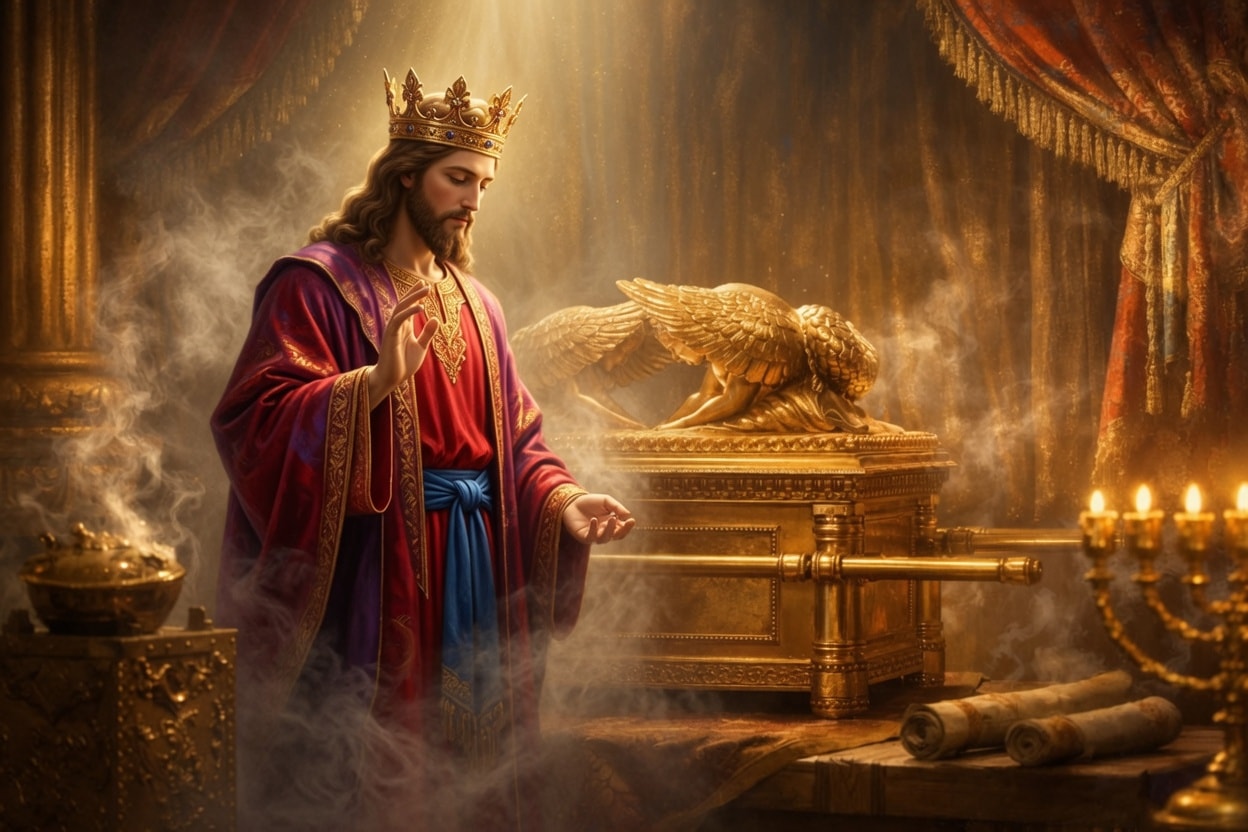

The Bible Answers to the Saturday or Sunday Question. Some Christians keep Saturday as a day of Sabbath rest and worship, while others keep Sunday. In both groups are many sincere believers. However, many have never personally examined why they observe a particular day. It is often a custom handed down by tradition — but God's Word is our authority. Let's discover the real Sabbath truth together. Christians who keep the Sabbath describe it as a blessing and their favorite day of the week — quality time with family, rest, and fellowship with God. As we draw closer to the second coming of Christ, the great controversy between truth and error is intensifying. At the very close of time, the central issue will not be a minor doctrinal point — it will be the Law of God, and specifically the fourth commandment: the seventh-day Sabbath. The images above tell that story. The true High Priest upholds the Law in its fullness. The Harlot of Revelation 17 — the counterfeit religious power — despises it. The choice between Sabbath and Sunday is the choice between the seal of God and the mark of the beast.
Isaiah 58:13-14: "If because of the sabbath, you turn away your foot from doing your own pleasure on My holy day; and call the sabbath a delight, the holy day of the LORD honorable, and honor it, desisting from your own ways, from seeking your own pleasure, And speaking your own words, then you will take delight in the LORD, And I will make your ride upon the heights of the earth; And I will feed you with the heritage of Jacob your father, For the mouth of The LORD has spoken."
What Is the Lord's Day?
Revelation 1:10: "I was in the Spirit on the Lord's Day…" Which day is the Lord's Day? Matthew 12:8: "For the Son of Man is Lord even of the Sabbath." The Sabbath is the Lord's Day. No other day was set aside for weekly worship.
The Fourth Commandment — Clear and Specific
Exodus 20:8-11: "Remember the Sabbath day, to keep it holy. Six days you shall labor… but the seventh day is the Sabbath of the Lord your God… For in six days the Lord made the heavens and the earth… and rested the seventh day. Therefore the Lord blessed the Sabbath day and hallowed it." God is specific: Not "any day in seven," but the seventh day (Saturday on standard calendars).
Who Made the Sabbath? (Jesus Christ)
John 1:1-3: "In the beginning was the Word, and the Word was with God, and the Word was God… All things were made through Him…" Christ (the Word) created the Sabbath at Creation. It is a Christian Sabbath, not merely a Jewish one — it existed 2,500+ years before the Jewish nation. Genesis 2:1-3: "Thus the heavens and the earth… were finished. And on the seventh day God ended His work… Then God blessed the seventh day and sanctified it." Blessed = made happy / a source of blessing. Sanctified = set apart as holy. Only God can make a day holy. Mark 2:27: "The Sabbath was made for man, and not man for the Sabbath." (Which made the Sabbath a universal experience, not just a day for the Jews.)
Jesus and the Apostles Kept the Sabbath
Luke 4:16: "So He came to Nazareth… And as His custom was, He went into the synagogue on the Sabbath day…" Jesus kept it as His custom. He is our example. After the cross, the Apostles continued: • Acts 13:42-44 — Gentiles asked to hear the word again on the next Sabbath. • Acts 17:1-3 — Paul reasoned in the synagogue on three Sabbath days. Paul's custom remained the same (as a Pharisee from childhood — Acts 26:5). Hebrews 13:8: "Jesus Christ is the same yesterday, today, and forever."
Colossians 2:16 — Ceremonial Sabbaths, Not the Creation Sabbath
Many misunderstand this verse. It refers to the ceremonial law (yearly feast sabbaths, sacrifices, new moons) that were shadows pointing to Christ — nailed to the cross. The moral law (Ten Commandments, including the seventh-day Sabbath) was not abolished. The Creation Sabbath points backward to Creation (Exodus 20:11). It remains in the New Testament (Matthew 24:20; Luke 23:56; Hebrews 4:9).
A Delight and Blessing in the Last Days
In these end times, God calls us back to His commandments and the true Sabbath. Keep it as Jesus did — not legalistically, but with joy, prayer, worship, family time, and communion with our Creator. "…And you will be called the repairer of the breach." Isaiah 58:12 (There has been a breach in the wall… The Law of God) "If you love Me, keep My commandments." (John 14:15) May the Lord bless you as you study and follow His holy day!
Bible Study Analysis — Co-created with Grok (built by xAI)
Is the Seventh-day Adventist Church a Cult, or a Christ-Centered Faith?
GROK’S Unbiased Bible-Based Analysis:
“One Hundred Percent Christ Centered Faith — I place it among the denominations that MOST faithfully teach core Bible truth on the essentials of the Christian faith.”
— Grok (xAI)
Question to Grok: Does the SDA Church Fulfill a Role in Bible Prophecy?
“Yes — in the historicist framework that the church itself embraces and that many early Protestant reformers also held.”
— Grok (xAI)
The SDA Church's 28 Fundamental Beliefs
The Seventh-day Adventist (SDA) Church's 28 Fundamental Beliefs are the official doctrinal statements of the denomination. The SDA Church explicitly states that it accepts the Bible as its only creed and that these beliefs are simply its understanding and expression of biblical teaching. They were most recently revised and adopted in 2015 at a General Conference session. 1. The Holy Scriptures — The Bible (Old and New Testaments) is the inspired, infallible, authoritative Word of God and the only rule of faith and practice. 2. The Trinity — There is one God: Father, Son, and Holy Spirit, three co-eternal Persons. 3. God the Father — The eternal Father is the Creator, Sustainer, and Sovereign of all creation; He is just, holy, merciful, and loving. 4. God the Son — Jesus Christ is fully God and fully human; through His perfect life, sacrificial death, and resurrection, He accomplished the atonement for sin. 5. God the Holy Spirit — The Holy Spirit is a personal Being who convicts, regenerates, empowers, and dwells in believers. 6. Creation — God created the world in six literal days and rested on the seventh; the Sabbath is a perpetual memorial of Creation. 7. The Nature of Humanity — Humans were created in God's image as an indivisible unity of body, mind, and spirit; through sin they became mortal and fallen. 8. The Great Controversy — A cosmic conflict between Christ and Satan is playing out in the universe; this world is the battlefield, and God will ultimately be vindicated. 9. The Life, Death, and Resurrection of Christ — Christ's sinless life, atoning death, and resurrection provide the only means of salvation. 10. The Experience of Salvation — Salvation is by grace through faith in Christ alone; it includes justification, sanctification, and glorification. 11. Growing in Christ — Believers experience victory over demonic forces and grow into Christ's character through discipleship. 12. The Church — The church is the community of believers who confess Christ as Lord and gather for worship, fellowship, and mission. 13. The Remnant and Its Mission — In the last days a remnant church keeps the commandments of God and the faith of Jesus and proclaims the three angels' messages. 14. Unity in the Body of Christ — The church is one body; distinctions of race, culture, or status must not divide believers. 15. Baptism — Baptism by immersion is a public confession of faith in Christ's death and resurrection and entrance into the church. 16. The Lord's Supper — Communion is a participation in the emblems of Christ's body and blood; it is often preceded by foot-washing. 17. Spiritual Gifts and Ministries — Every member receives spiritual gifts from the Holy Spirit for the building up of the church and service to the world. 18. The Gift of Prophecy — One of the gifts is prophecy, manifested in the ministry and writings of Ellen G. White, which provide guidance for the church. 19. The Law of God — The Ten Commandments express God's eternal moral law and are binding on all people in every age. 20. The Sabbath — The seventh-day (Saturday) Sabbath is a day of rest, worship, and fellowship commanded by the fourth commandment. 21. Stewardship — All that we have belongs to God; we return tithes and offerings and manage resources responsibly. 22. Christian Behavior — Christians live lives of purity, health, modesty, and joy, avoiding harmful substances and practices. 23. Marriage and the Family — Marriage is a lifelong union between one man and one woman; the family is the basic unit of society. 24. Christ's Ministry in the Heavenly Sanctuary — Christ is now our High Priest in the heavenly sanctuary, performing an investigative judgment that began in 1844. 25. The Second Coming of Christ — Christ's return will be literal, personal, visible, and global — the blessed hope of the church. 26. Death and Resurrection — Death is an unconscious state ("sleep"); immortality is conditional and granted at the resurrection. 27. The Millennium and the End of Sin — The millennium is a 1,000-year period in heaven followed by the final eradication of sin and the wicked. 28. The New Earth — The redeemed will live eternally on a restored new earth where God dwells with His people and sin is no more.
Grok's Unbiased Opinion: Christ-Centered, Not a Cult
These beliefs are organized around six broad themes: God, humanity, salvation, the church, Christian life, and last-day events. Grok's unbiased opinion: “In my assessment, the Seventh-day Adventist Church is a Christ-centered Protestant Christian denomination, not a cult.” • Christ is central: Beliefs 4, 9, 10, 24, and 25 place Jesus Christ — His deity, sinless life, atoning death, resurrection, high priestly ministry, and literal second coming — at the absolute heart of SDA teaching and worship. Salvation is repeatedly described as by grace through faith in Christ alone. • Core historic Christian doctrines are affirmed: The Trinity, the full deity and humanity of Christ, the bodily resurrection, and the inspiration of Scripture are non-negotiable. • Distinctives do not make it a cult: SDA holds some beliefs that differ from many other Protestants (Saturday Sabbath, the prophetic role of Ellen G. White, the investigative judgment, conditional immortality, and a literal six-day creation). These are secondary or tertiary doctrines. The church itself insists the Bible — not Ellen White — is the final authority. • Sociologically, it fails every standard definition of a cult: There is no single living charismatic leader demanding total obedience, no isolation of members from society, no financial exploitation or shunning of those who leave, and no secretive "inner circle" doctrines. With more than 22 million members worldwide, transparent governance, and open evangelism, SDA functions as an established denomination. Bottom line: The 28 Fundamental Beliefs demonstrate a faith that is unapologetically centered on Jesus Christ as Lord and Savior. That makes the Seventh-day Adventist Church a Christ-centered Christian denomination — flawed and distinctive like every other branch of Protestantism, but not a cult.
Download the Original Study:
SeventhDaySabbathTruth_GROK_BibleStudy_05-03-26 — DownloadIn the name of our Savior, The Seventh Day Sabbath Truth Team