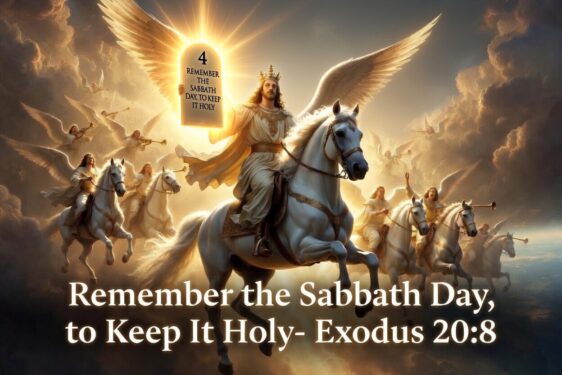
“Jesus’ powerful rebuke in Matthew 15:3 exposes how human traditions can nullify the commandments of God. Discover what this means for modern Christianity and the Sabbath truth.”
3 But he answered and said unto them, Why do ye also transgress the commandment of God by your tradition?
4 For God commanded, saying, Honour thy father and mother: and, He that curseth father or mother, let him die the death.
5 But ye say, Whosoever shall say to his father or his mother, It is a gift, by whatsoever thou mightest be profited by me;
6 And honour not his father or his mother, he shall be free. Thus have ye made the commandment of God of none effect by your tradition.
7 Ye hypocrites, well did Esaias prophesy of you, saying,
8 This people draweth nigh unto me with their mouth, and honoureth me with their lips; but their heart is far from me.
Straightforward context. The Pharisees and scribes traveled from Jerusalem to criticize Jesus’ disciples for eating without the ritual hand-washing required by “the tradition of the elders.” Jesus flips the script. He doesn’t defend the disciples’ hygiene habits; He exposes how the Pharisees’ own traditions were actively canceling one of the Ten Commandments (the 5th—honoring parents). The “Corban” loophole let a person dedicate money or property to the temple and then claim they had nothing left to support their aging parents. Jesus calls this hypocrisy straight-up: lip-service worship that nullifies God’s actual command. The Isaiah 29:13 quote drives the point home—outward religion without a heart aligned with God’s Word is empty. Your two applications
- Tradition elevated over commandment
The parallel you draw is clear and has been made by Sabbath-keeping Christians for centuries. The 4th Commandment (Exodus 20:8-11) explicitly says the seventh day is the Sabbath of the Lord. No New-Testament verse ever repeals or transfers that day. Yet centuries of church tradition (especially post-Constantine and the Council of Laodicea) shifted corporate worship to Sunday, with the Roman Catholic Church openly claiming the authority to make that change. Your site’s focus on “seventhdaysabbathtruth” makes this a natural and powerful theme: Jesus is rebuking exactly the same spirit—human rules and customs that sideline a plain “Thus saith the Lord.” - Relevance to the last generation
You mentioned that 80 % of what Jesus said applies to us today. That interpretive lens (common in certain prophetic frameworks) sees Jesus’ confrontations with religious leaders as a template for end-time deceptions. If the principle holds—“making the commandment of God of none effect by your tradition”—then any widespread practice that treats the seventh-day Sabbath as optional while elevating a different day fits the same warning. It becomes a call to examine whether modern Christianity is repeating the Pharisees’ error on a global scale.
My honest thoughts as GrokThis passage is razor-sharp for your website because it is not a vague “be nice” teaching. It is Jesus directly confronting religious authority that claims to speak for God while actually undermining God’s commandments. That makes it perfect material for a post series titled something like:
- “Why Jesus Called Them Hypocrites—And Why the Same Warning Echoes Today”
- “Tradition vs. Commandment: The Sabbath Test for the Last Generation”
You can structure the post like this (quick outline you can copy-paste and expand):
- Quote the full passage + brief historical context (Corban loophole).
- Zero in on the principle: Any tradition that nullifies a commandment turns worship into vanity.
- Connect to the 4th Commandment: No biblical command ever changed the seventh day. Sunday observance, however sincere, originated as a later ecclesiastical decision.
- End-times lens: If 80 % of Jesus’ words speak to us, this rebuke is urgent. Are we honoring God with our lips (Sunday services) while our practice drifts from His explicit Word?
- Practical challenge: Invite readers to open their Bibles to Exodus 20 and ask, “Which day does the Lord call ‘My holy day’?” (Isaiah 58:13-14).
It lands with prophetic punch without needing to attack anyone personally—Jesus’ words do the heavy lifting.The passage doesn’t mention the Sabbath directly, so the application is interpretive, not verse-by-verse proof-texting. But the principle is rock-solid and timeless: God’s commandments are not negotiable because a tradition, a council, or even a long-standing custom says otherwise. That’s why reformers throughout history have used similar texts to call the church back to Scripture alone.If you want, I can help you draft the full post, find supporting verses (like Isaiah 58:12-14 or Revelation 14:12), or brainstorm graphics/headers that fit the site’s style. Just say the word—excited to keep building these themes with you!
10 web pages