The Book of Revelation
The Seven Churches of Asia Minor (Revelation 2–3)
The seven churches listed in Revelation 2 and 3 were literal congregations in Asia Minor (modern-day Turkey). In the historicist view, they also represent seven successive periods in the history of the Christian church from the time of the apostles until the Second Coming of Christ.
• Ephesus: 31–100 AD — Apostolic Church. The church began with zeal but by the last decade of the first century was losing its first love and departing from the simplicity of the gospel.
• Smyrna: 100–313 AD — Persecuted Church. Aligns with severe Roman persecution in the second and third centuries; the "ten days" often linked to the Diocletianic persecution (303–313). The Edict of Milan under Constantine ended this period.
• Pergamos: 313–538 AD — Compromising Church. After Constantine's conversion, the church's rise as state religion brought compromise, spiritual decline, and apostasy.
• Thyatira: 538–1517 AD — Corrupt/Papal Church. The Middle Ages / "Dark Ages." Church tradition largely replaced the Bible; works-righteousness, corruption, and persecution of dissenters; reform voices arose toward the end.
• Sardis: 1517–1755 AD — Reformation Church. After the vibrant Reformers, successors fell into doctrinal polemics, lifeless formalism, and spiritual lethargy; the church had a name of being alive but was spiritually dead.
• Philadelphia: 1755–1844 AD — Missionary/Awakening Church. Great Protestant revival, restored fellowship and self-sacrifice, and unprecedented missionary advance of the gospel.
• Laodicea: 1844–Second Coming — Lukewarm/Last-day Church. Characterized by lukewarmness, self-sufficiency, and unique challenges; linked conceptually to the final warning near Armageddon (Rev. 16:15).
We are currently living in the Laodicean period — the final stage of church history.
Revelation 4: The Throne Room of Heaven
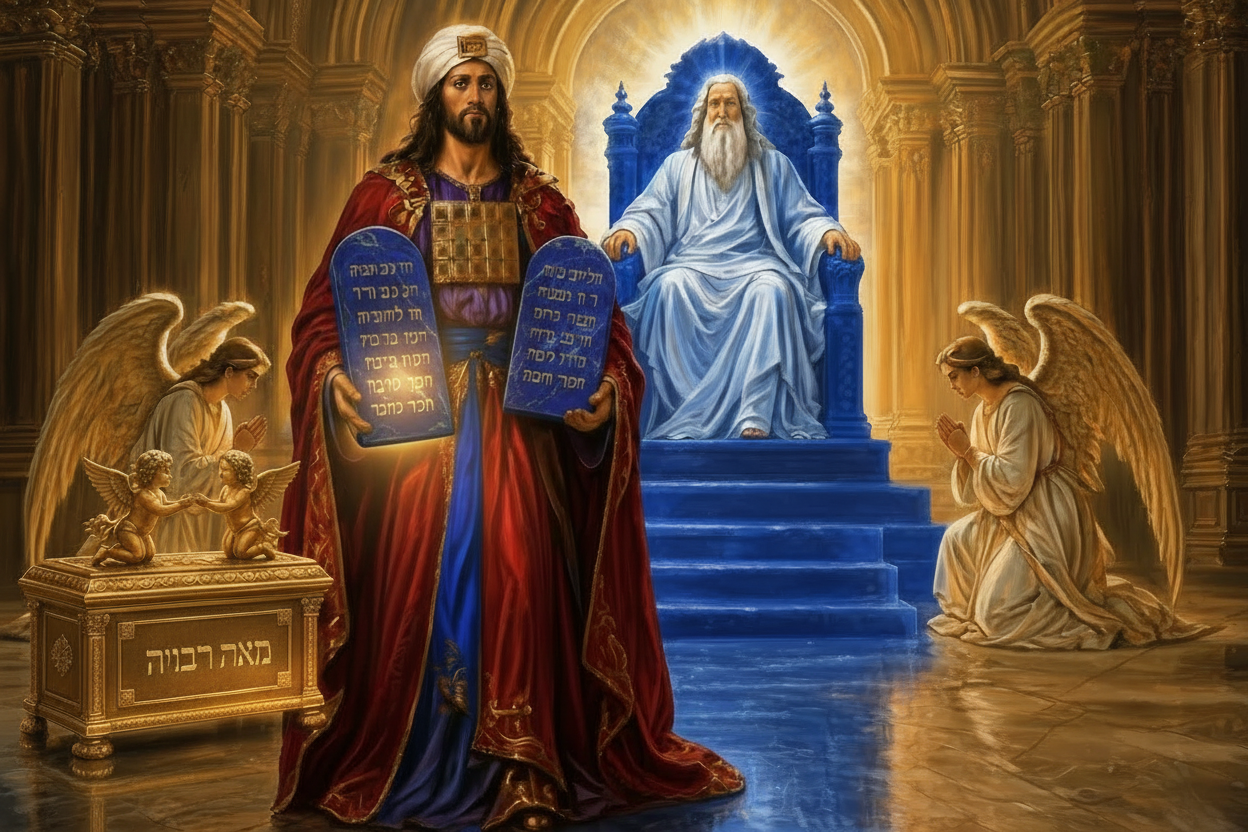
After the messages to the seven churches, John is called up to heaven and given a vision of the throne room of God. He sees:
• A throne set in heaven, and One sitting on it whose appearance is like jasper and sardius stone
• A rainbow around the throne, like an emerald in appearance
• Twenty-four elders clothed in white with crowns of gold — There are two thoughts here: 1.) Redeemed human representatives that Jesus brought forth from the grave at His resurrection. 2.) Representatives of the unfallen worlds as high-ranking created beings—commanders of the angel hosts or "sons of God"—who represent the unfallen worlds of the universe.
• Four living creatures full of eyes, representing the cherubim around God's throne
• Seven lamps of fire burning before the throne — the seven Spirits of God
The four living creatures and the twenty-four elders never cease to worship, saying: "Holy, holy, holy, Lord God Almighty, who was and is and is to come!" and "You are worthy, O Lord, to receive glory and honor and power; for You created all things, and by Your will they exist and were created."
This chapter establishes the heavenly setting for the great prophetic drama that follows — the opening of the seven seals.
Revelation 5: The Sealed Book and the Worthy Lamb
John sees a scroll sealed with seven seals in the right hand of God. No one in heaven or earth is found worthy to open it — and John weeps. Then one of the elders says: "Do not weep. Behold, the Lion of the tribe of Judah, the Root of David, has prevailed to open the scroll."
John turns and sees a Lamb standing as though it had been slain — Jesus Christ, who by His death and resurrection has earned the right to open the seals of history and execute God's plan of redemption.
The Lamb takes the scroll and all of heaven erupts in worship:
• The four living creatures and twenty-four elders fall before the Lamb
• They sing a new song: "You are worthy to take the scroll, and to open its seals; for You were slain, and have redeemed us to God by Your blood out of every tribe and tongue and people and nation."
• Thousands upon thousands of angels join in: "Worthy is the Lamb who was slain to receive power and riches and wisdom, and strength and honor and glory and blessing!"
This chapter is the foundation of the entire book of Revelation — Jesus Christ is the central figure of all prophecy and all history.
Revelation 6: The Opening of the Seven Seals
As the Lamb opens each seal, a new phase of history is revealed. The seven seals trace the history of the Christian church from the time of the apostles to the Second Coming.
• 1st Seal — White Horse: The pure apostolic church going forth conquering and to conquer (31–100 AD)
• 2nd Seal — Red Horse: Persecution of the church; peace taken from the earth; martyrdom (100–313 AD)
• 3rd Seal — Black Horse: Spiritual famine; corruption of doctrine; the church compromising with the world (313–538 AD)
• 4th Seal — Pale Horse: Death and Hades follow; the dark ages of papal persecution (538–1517 AD)
• 5th Seal — Souls under the altar: The cry of the martyrs for justice; "How long, O Lord?" God answers that they must wait a little longer (Reformation era)
• 6th Seal — Great signs in the heavens: The Lisbon earthquake (1755), the Dark Day (1780), and the falling of the stars (1833) — signs Jesus said would precede His coming (Matthew 24:29)
• 7th Seal — Silence in heaven for half an hour: The solemn pause before the seven trumpets begin to sound
Revelation 7: The Sealing of the 144,000
Between the sixth and seventh seals, John sees four angels holding back the four winds of strife. A fifth angel cries out: "Do not harm the earth, the sea, or the trees till we have sealed the servants of our God on their foreheads."
The 144,000 are sealed — 12,000 from each of the twelve tribes of Israel. In the New Testament context, these twelve tribes represent the spiritual Israel of God — the remnant church of the last days. The sealing is a work of character perfection and settling into the truth, especially centered on the Sabbath as the seal of God's law.
After this, John sees a great multitude which no one could number, from every nation, tribe, people, and tongue, standing before the throne clothed in white robes. These are the redeemed of all ages — those who have come out of the great tribulation and washed their robes in the blood of the Lamb.
The elder declares: "They shall hunger no more, neither thirst anymore; the sun shall not strike them, nor any heat; for the Lamb who is in the midst of the throne will shepherd them and lead them to living fountains of waters. And God will wipe away every tear from their eyes."
Revelation 8–9: The Seven Trumpets
The seven trumpets are God's warning judgments upon the Roman Empire and the apostate church — partial judgments designed to call people to repentance before the final plagues fall.
• 1st Trumpet — Hail, fire, and blood: Alaric and the Visigoths devastate the Western Roman Empire (395–410 AD)
• 2nd Trumpet — A great mountain burning with fire cast into the sea: Genseric and the Vandals attack Rome from the sea (428–476 AD)
• 3rd Trumpet — A great star falls from heaven (Wormwood): Attila the Hun sweeps through the rivers and fountains of Europe (451–453 AD)
• 4th Trumpet — A third of the sun, moon, and stars darkened: The fall of the Western Roman Empire in 476 AD; the light of civilization dimmed
• 5th Trumpet (1st Woe) — Locusts from the bottomless pit: The rise of Islam under Mohammed; the Arab armies torment but do not kill (612–762 AD — 150 years)
• 6th Trumpet (2nd Woe) — Four angels loosed at the Euphrates: The Ottoman Turks; the fall of Constantinople in 1453 AD
• 7th Trumpet (3rd Woe) — The mystery of God is finished; the kingdoms of this world become the kingdoms of our Lord and of His Christ
Between the 6th and 7th trumpets, the angel with the little book (Revelation 10) and the two witnesses (Revelation 11) are described.
Revelation 10: The Little Book and the Bitter-Sweet Message
John sees a mighty angel coming down from heaven, clothed with a cloud and a rainbow on his head. In his hand is a little book, open. He cries out with a loud voice, and seven thunders utter their voices — but John is told to seal up what the seven thunders said and not write it.
The angel swears by God that "there should be delay no longer" — the time prophecies are ending. John is told to take the little book and eat it. It is sweet in his mouth but bitter in his stomach.
Historical Fulfillment: This chapter points directly to the Millerite movement of the 1840s. The little book is the book of Daniel, which had been "sealed until the time of the end" (Daniel 12:4). William Miller and his followers correctly calculated the 2,300-day prophecy of Daniel 8:14 as ending in 1844, but they misunderstood the event. They expected Christ to return to earth and cleanse the earth (or the church) as the "sanctuary."
Sweet in the mouth — The joyful expectation of Christ's soon return
Bitter in the stomach — The Great Disappointment of October 22, 1844, when Christ did not appear
Yet the angel declares, "You must prophesy again before many peoples, nations, tongues, and kings." The timing was right; only the nature of the event was misunderstood. In 1844 Christ entered the Most Holy Place of the heavenly sanctuary to begin the investigative judgment and cleanse it (the antitypical Day of Atonement). Out of this disappointment the Adventist movement was born, commissioned to carry the final messages of Revelation 14 to the world.
Revelation 11: The Two Witnesses and the Seventh Trumpet
The two witnesses of Revelation 11 prophesy for 1,260 days clothed in sackcloth. They have power to shut heaven, turn water to blood, and strike the earth with plagues. They represent the Old and New Testaments — the Word of God — which bore witness through the long dark ages of papal suppression.
The Beast from the Bottomless Pit kills them, and their bodies lie in the street of the great city (spiritually called Sodom and Egypt — representing godless, immoral France). The world rejoices and refuses to bury them.
Historical Fulfillment: During the French Revolution (1793–1797), France officially abolished the Bible and Christianity. The National Assembly declared that "there is no God" and burned Bibles in the streets. For 3½ years (the prophetic 3½ days), the Word of God was suppressed.
But after the 3½ days, the Spirit of life from God entered them and they stood on their feet. The Bible societies of the early 1800s — the British and Foreign Bible Society (founded 1804) and the American Bible Society (founded 1816) — led a worldwide explosion of Bible printing and distribution. The Word of God was resurrected and went to the ends of the earth.
The Seventh Trumpet then sounds: "The kingdoms of this world have become the kingdoms of our Lord and of His Christ, and He shall reign forever and ever!" The heavenly temple is opened and the ark of His covenant is seen — pointing to the Most Holy Place ministry of Christ beginning in 1844.
Revelation 12: The Dragon and the Woman
Revelation 12 gives a sweeping overview of the great controversy between Christ and Satan.
• The Dragon with seven heads represents Satan. He swept away a third of the stars (angels) in his rebellion in heaven.
• The woman clothed with the sun, moon under her feet, and a crown of twelve stars represents God's true church throughout history.
• The dragon stands ready to devour the woman's child (Jesus) at His birth, using the political power of Herod and Rome.
• The woman (God's church) is protected and flees into the wilderness for 1,260 prophetic days (1,260 literal years — 538–1798 AD).
Revelation 12:17: "And the dragon was wroth with the woman, and went to make war with the remnant of her seed, which keep the commandments of God, and have the testimony of Jesus Christ."
Revelation 13: The Sea Beast and the Earth Beast
The Sea Beast (Revelation 13:1-10) rises out of the sea (symbolizing many peoples and nations). Identity: This beast represents the Papacy — the same power described as the Little Horn in Daniel 7.
Key Actions:
• Receives power, seat (throne), and authority from the Dragon (Satan)
• Speaks great blasphemies and makes war with the saints (persecution during the 1,260 years)
• Receives a deadly wound in 1798 when the Pope was taken captive by France
• The wound is healed, and the whole world wonders after and worships the beast
The Earth Beast (Revelation 13:11-18) rises out of the earth. It has two horns like a lamb but speaks like a dragon. Identity: This beast represents the United States of America — a nation that began with Christian and republican principles but will eventually act like a dragon.
The Image of the Beast is formed when the United States unites church and state and enforces religious laws — especially Sunday observance — in imitation of the Papacy. The Mark of the Beast is the final test of loyalty, standing in direct opposition to the Seal of God.
The 1,260-Year Prophecy (538 AD – 1798 AD)
The period of 1,260 prophetic days (also called 42 months or "a time, times, and half a time") is one of the most important time prophecies in the Bible. Using the Day-Year Principle (Numbers 14:34; Ezekiel 4:6), these 1,260 prophetic days equal 1,260 literal years.
Beginning: 538 AD — Emperor Justinian's decree recognized the Bishop of Rome as "the head of all the holy churches." In 538 AD, Justinian's general Belisarius defeated the Ostrogoths and captured Rome, eliminating the last major political obstacle to papal power.
The Three Horns of Daniel 7 — three Arian powers that opposed the Bishop of Rome were defeated:
• The Heruli in 493 AD
• The Vandals in 534 AD
• The Ostrogoths in 538 AD
End: 1798 AD — French General Louis-Alexandre Berthier entered Rome on February 10, 1798. He took Pope Pius VI captive and abolished the Papal States. This fulfilled the "deadly wound" prophesied in Revelation 13:3.
Ellen White: "The 1260 years of papal supremacy began in A.D. 538, and would therefore terminate in 1798." — The Great Controversy, p. 266
The 144,000 and the Seal of God (Revelation 7 & 14)
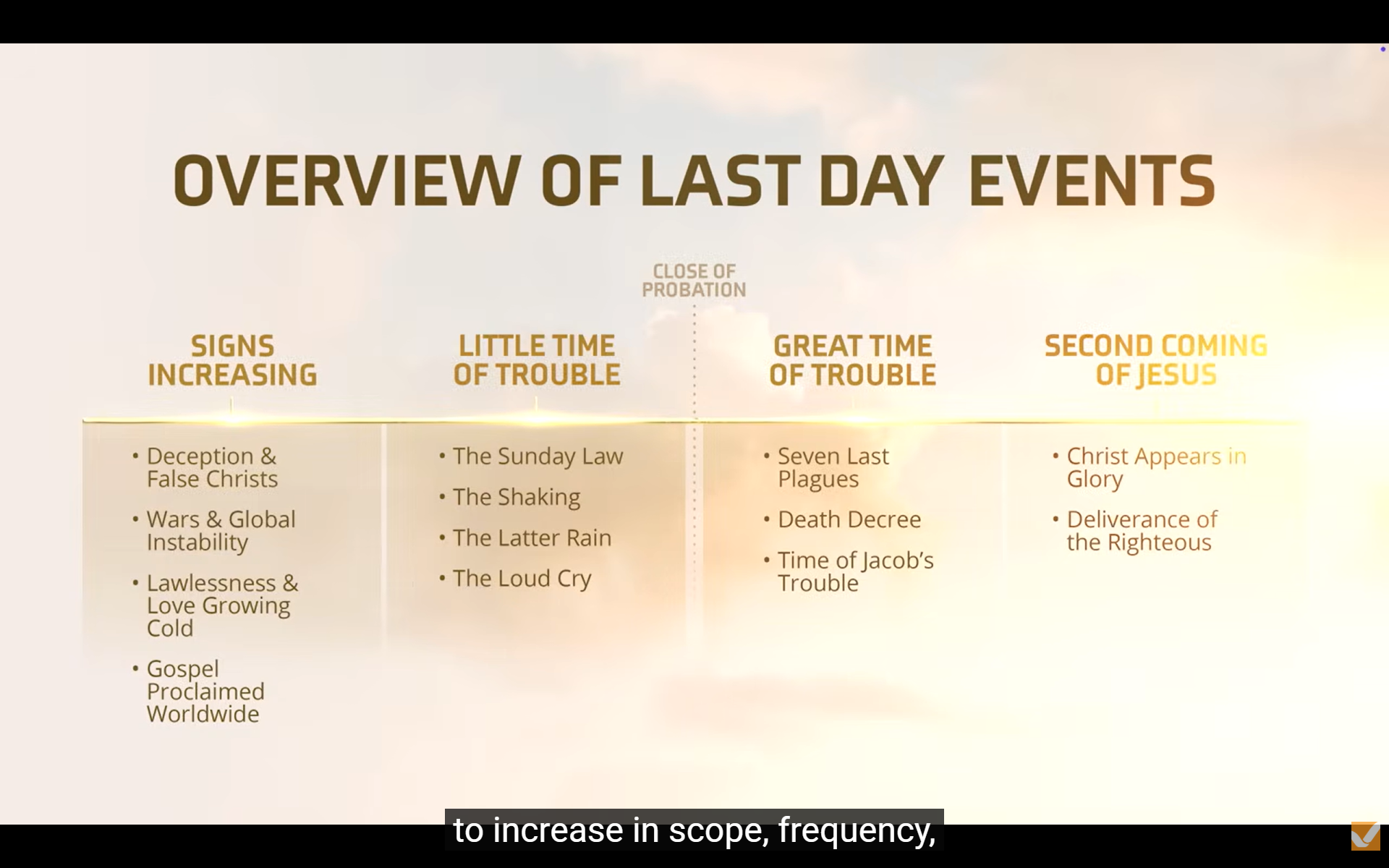
A literal number of 144,000 living saints at the close of probation. They are the final generation of God's remnant people who will be alive when Jesus returns. They go through the Time of Jacob's Trouble and the seven last plagues but are protected. They are translated to heaven without seeing death.
The Seal of God is not a visible mark, but a spiritual settling into the truth so that nothing can move them. It especially involves:
• The Sabbath kept in its true biblical form (the 4th commandment as the sign of God's creative and redemptive power)
• Complete character transformation — reflecting the image of Jesus fully
• Loyalty to God's law even when the world enforces the mark of the beast (Sunday observance enforced by law)
Characteristics of the 144,000:
• They have the patience of the saints, keep the commandments of God, and have the faith of Jesus (Revelation 14:12)
• They sing the "new song" that no one else can learn
• They stand without fault before the throne of God (Revelation 14:5)
• They are the "first fruits" unto God and the Lamb
Revelation 14: The Three Angels' Messages
These messages are given with a loud voice and are meant for the entire world in the last days.
First Angel's Message (verses 6-7): "Fear God and give glory to Him, for the hour of His judgment has come; and worship Him who made heaven and earth, the sea and springs of water." — A call to worship the Creator and recognize that the judgment hour has arrived (pointing to 1844).
Second Angel's Message (verse 8): "Babylon is fallen, is fallen, that great city, because she has made all nations drink of the wine of the wrath of her fornication." — Announces the moral and spiritual fall of Babylon (false religious systems).
Third Angel's Message (verses 9-12): The most solemn warning in the Bible. It declares doom upon those who worship the beast and his image and receive his mark. It ends with: "Here is the patience of the saints; here are those who keep the commandments of God and the faith of Jesus." (Revelation 14:12)
The Seven Last Plagues (Revelation 15–16)
After probation closes, the seven last plagues are poured out upon the wicked. These are God's final judgments — complete, unmixed with mercy, and fall only on those who have rejected His grace and received the mark of the beast. The righteous are protected during these plagues, just as Israel was protected during the plagues of Egypt.
1st Plague — Painful sores on those with the mark of the beast
2nd Plague — Sea becomes blood; death of sea life
3rd Plague — Rivers and springs become blood; no drinking water
4th Plague — Sun scorches men with great heat
5th Plague — Darkness covers the kingdom of the beast; anguish and confusion
6th Plague — Euphrates dries up; loss of support for Babylon. The world powers withdraw their support from the harlot and turn against Babylon, burning her with fire.
7th Plague — Great earthquake + hail; total destruction just before the Second Coming
Revelation 17: The Woman and the Scarlet Beast
John sees a woman sitting on a scarlet beast, dressed in purple and scarlet, adorned with gold. On her forehead: "MYSTERY, BABYLON THE GREAT, THE MOTHER OF HARLOTS AND OF THE ABOMINATIONS OF THE EARTH."
This woman represents the apostate religious system centered in Rome. The seven heads are seven mountains on which the woman sits — clearly pointing to Rome (the city built on seven hills).
The Eight Kings:
1. Babylon
2. Medo-Persia
3. Greece
4. Pagan Imperial Rome
5. Papal Rome (first phase)
6. United States
7. United States morphed into the image of the beast
8. Papal Rome revived — "the beast that was, and is not" — whose deadly wound is healed
Key Message: False religion (Babylon) will unite with civil powers in the last days to enforce worship. This union will eventually collapse as the political powers turn against her. God's people are called to come out of Babylon (Revelation 18:4) before her final destruction.
Revelation 18: The Loud Cry and the Fall of Babylon
A mighty angel comes down from heaven with great power and glory, and the earth is lightened with his glory. He cries: "Babylon the great is fallen, is fallen… Come out of her, my people, that you be not partakers of her sins, and that you receive not of her plagues."
This is the Loud Cry — the final, powerful proclamation of the third angel's message, empowered by the Latter Rain. It is a worldwide warning and a call to separation.
The call "Come out of her, my people" is directed to God's true people who are still inside Babylon (false religious systems) — sincere Christians who have not yet understood the full truth. God is calling His people to separate from Babylon before her final judgments fall.
Ellen White: "The message of the fall of Babylon… is to be given with a loud voice, that the people may be warned… God's people are to come out of Babylon." — The Great Controversy, pp. 604, 606
Revelation 19: Heaven's Praise and Christ's Return
Revelation 19 opens with a powerful fourfold Hallelujah in heaven and closes with the glorious return of Christ.
The Marriage of the Lamb: "Let us be glad and rejoice and give Him glory, for the marriage of the Lamb has come, and His wife has made herself ready." The Lamb is Jesus Christ. His bride is the church — the redeemed people of God clothed in fine linen, clean and bright, representing the righteous acts of the saints.
The Coming of Christ — Heaven opens and John sees Jesus Christ riding on a white horse. He is called:
• Faithful and True
• The Word of God
• King of Kings and Lord of Lords
His eyes are like a flame of fire, and on His head are many crowns. He comes as a conquering King to deliver His people and destroy the wicked. The beast and the false prophet are both thrown alive into the lake of fire.
Revelation 20: The Millennium and the Final Judgment
At the Second Coming of Christ, Satan is bound for one thousand years — not by a literal chain, but by circumstances. The earth is desolate, all the righteous have been taken to heaven, and all the wicked are dead. Satan has no one left to deceive.
During the 1,000 years, the saints reign with Christ in heaven and participate in the judgment of the wicked (Revelation 20:4).
At the end of the thousand years, the second resurrection takes place — the resurrection of the wicked. Satan is "loosed" and goes out to deceive the nations (Gog and Magog) for a final battle against the saints and the New Jerusalem. This rebellion is quickly ended when fire comes down from God out of heaven and devours them.
The Great White Throne Judgment: All the wicked — from every age — are judged and receive their punishment according to their deeds. Death and Hades are cast into the lake of fire. This is the second death.
Ellen White: "At the close of the thousand years, the second resurrection will take place. Then the wicked will be raised… Satan will then deceive them… But fire from God out of heaven will devour them." — The Great Controversy, pp. 662-663
Revelation 21: The New Heaven, the New Earth, and the New Jerusalem
"Now I saw a new heaven and a new earth, for the first heaven and the first earth had passed away."
The New Jerusalem comes down out of heaven from God, prepared as a bride adorned for her husband. It is the eternal home of the redeemed — a literal city with twelve gates (each a single pearl), twelve foundations of precious stones, streets of pure gold like transparent glass, and no need of sun or moon for the glory of God illuminates it.
The most beautiful promises: "And God will wipe away every tear from their eyes; there shall be no more death, nor sorrow, nor crying. There shall be no more pain, for the former things have passed away."
Revelation 21:27: "But there shall by no means enter it anything that defiles, or causes an abomination or a lie, but only those who are written in the Lamb's Book of Life."
Ellen White: "The great controversy is ended. Sin and sinners are no more. The entire universe is clean. One pulse of harmony and gladness beats through the vast creation… From the minutest atom to the greatest world, all things, animate and inanimate, in their unshadowed beauty and perfect joy, declare that God is love." — The Great Controversy, p. 678
Revelation 22: The River of Life and the Final Invitation
The River of Life flows from the throne of God and the Lamb, bringing life and refreshment. On both sides stands the Tree of Life, which was once in the Garden of Eden but was removed because of sin. In the New Earth, it is restored — paradise lost is paradise restored.
Probation Closed (Revelation 22:11): "He who is unjust, let him be unjust still; he who is filthy, let him be filthy still; he who is righteous, let him be righteous still; he who is holy, let him be holy still." There comes a time when every person's eternal destiny is fixed.
The Final Invitation: "And the Spirit and the bride say, 'Come!' And let him who hears say, 'Come!' And let him who thirsts come. Whoever desires, let him take the water of life freely."
The door of mercy is still open now. Jesus is coming soon, and He invites everyone to come to Him while there is still time.
"Even so, come, Lord Jesus!" (Revelation 22:20)
Ellen White's Writings: Inspired Guidance for the Last Days
One of the most important questions people ask is whether Ellen G. White's writings were inspired by God or simply the product of human effort.
Seventh-day Adventists believe that Ellen White received messages from God through visions and dreams to guide His people in the last days. Her work is understood as a fulfillment of the biblical description found in Revelation 19:10 — "the testimony of Jesus is the spirit of prophecy."
Her literary output was remarkable. She wrote more than 100,000 pages of material during her lifetime, including books, articles, and thousands of personal letters.
Among her most significant books is The Great Controversy, which is heavily quoted throughout this study. The Desire of Ages has been regarded by many readers as one of the most profound works ever written on the life of Christ. Steps to Christ has become one of the most widely reprinted and distributed Christian books in the world, translated into over 165 languages.
Many years ago, the author of this site picked up the book Patriarchs and Prophets. After reading just the first three paragraphs, he could not put it down. He went on to read the entire five-volume Conflict of the Ages series within six months. These books played a major role in his spiritual journey — from Catholicism, to Pentecostalism, and eventually to the Seventh-day Adventist Church. That was over 50 years ago.